
Lifestyle
Lifestyle is where training meets real life. These articles explore motivation, habits, identity, and balance, acknowledging that fitness doesn’t exist in a vacuum. Whether you’re navigating stress, aging, performance goals, or simply trying to stay consistent, this section is about building a relationship with fitness that’s resilient, adaptable, and meaningful over the long haul.

It’s Only as Complicated As You Want It to Be
Why Bad Habits Are So Hard to Break and How to Make Building Good Ones Easy
The Problem with “Good for You” and “Bad for You”
Goal-Setting and Finding Balance with a High-Performance Life
Low-Hanging Fruit for Reducing Stress in Your Everyday Life
The Muscle-Building Hierarchy
Balancing Strength Training, Conditioning, and Other Fitness Endeavors
Motivation vs. Discipline
Fitness Trends: What to Watch Our For
What is Body Dysmorphia?
I’m Over 70 — Is it Too Late for Me to Hit the Gym?
I’m Under 15 — Is it Too Early for Me to Hit the Gym?
How to Be a Client: What You Can Get Out of Personal Training

Lifestyle
Lifestyle is where training meets real life. These articles explore motivation, habits, identity, and balance, acknowledging that fitness doesn’t exist in a vacuum. Whether you’re navigating stress, aging, performance goals, or simply trying to stay consistent, this section is about building a relationship with fitness that’s resilient, adaptable, and meaningful over the long haul.
It’s Only as Complicated As You Want It to Be
Spend enough time in the fitness and nutrition world and it starts to feel like a graduate seminar. Energy balance models. Macronutrient ratios. Gut microbiome diversity. Supplement hierarchies. Alcohol risk curves. Ultra-processed food classifications. All of it matters. None of it is required to get strong, improve your health, or change your body. Fitness is only as complicated as you want it to be.
Why Bad Habits Are So Hard to Break and How to Make Building Good Ones Easy
Most people don’t struggle with fitness because they lack information. They struggle because they’re human.
The Problem with “Good for You” and “Bad for You”
Flexibility in Wellness and Strategies for Navigating a Healthy Lifestyle
Goal-Setting and Finding Balance with a High-Performance Life
A reflection on balance, intensity, moderation, and stress, and goals
Low-Hanging Fruit for Reducing Stress in Your Everyday Life
Stress management is often packaged as something elaborate — structured breathwork routines, ice baths, supplements, perfectly curated morning rituals. Most people don’t need more complexity. They need fewer daily friction points.
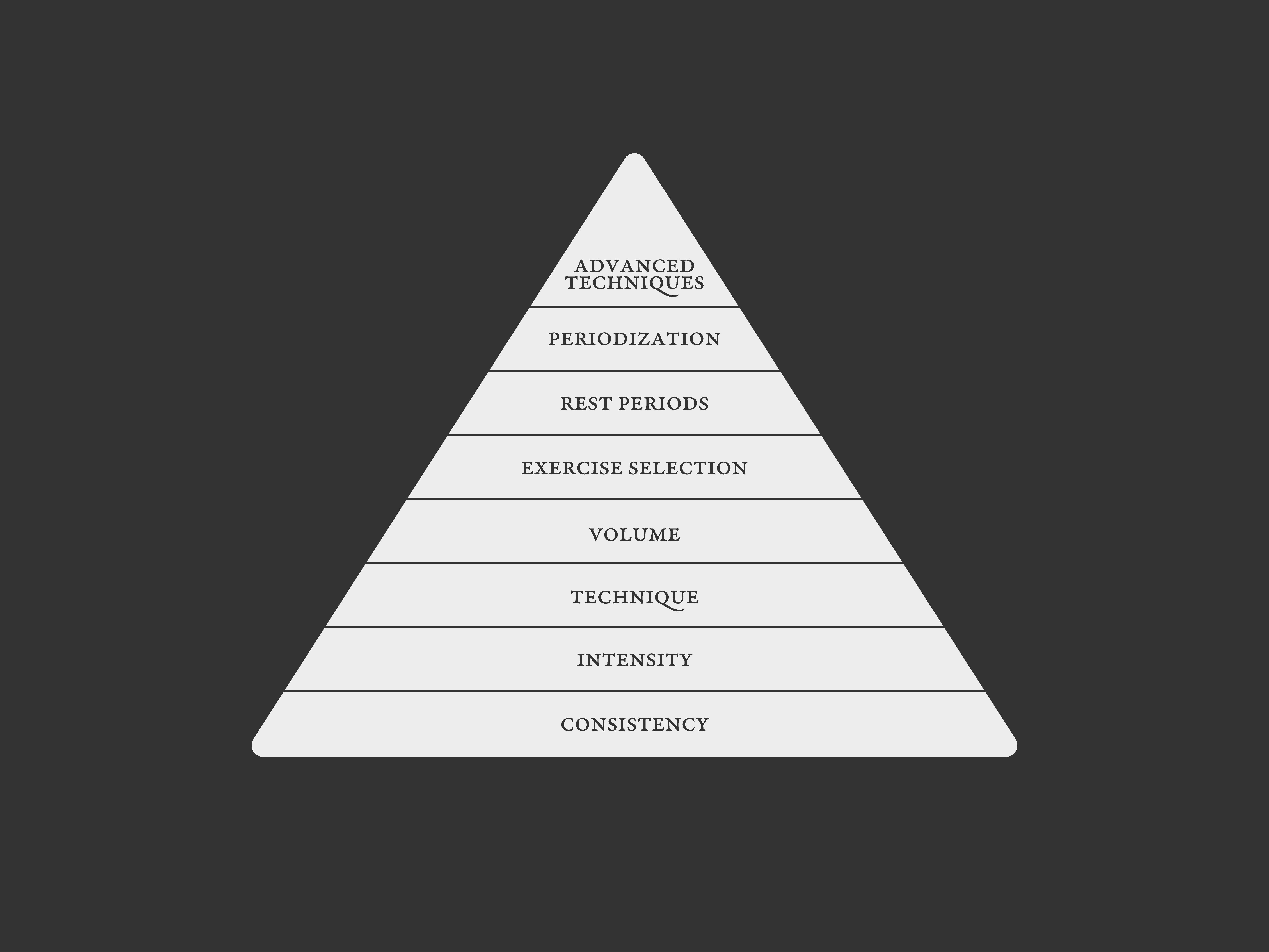
The Muscle-Building Hierarchy
Most lifters search for growth in the wrong places. Tweak rest periods. They experiment with intensity techniques, debating optimal exercise variations. Meanwhile, the real limiter often sits at the bottom of the pyramid.
Balancing Strength Training, Conditioning, and Other Fitness Endeavors
Very few people train in a vacuum. The question eventually arises: how do you pursue strength, conditioning, and sport without everything competing against everything else?
Motivation vs. Discipline
If your fitness depends on motivation, it will rise and fall with sleep, stress, weather, mood, and convenience. Some days you’ll feel unstoppable. Other days you won’t negotiate with yourself at all. Long-term progress requires something steadier.
Fitness Trends: What to Watch Our For
The fitness industry runs on novelty. Every year brings a new protocol, a new recovery tool, a new training split, a new supplement stack, a new claim about what’s “outdated” and what’s “revolutionary.”
What is Body Dysmorphia?
In fitness spaces, dissatisfaction is common. People want more muscle. Less fat. Better proportions. Sharper definition. Improved symmetry. Improvement goals are normal. Body dysmorphia is something different.
I’m Over 70 — Is it Too Late for Me to Hit the Gym?
This question usually carries more than curiosity. It carries hesitation, concern about injury,, uncertainty about where to start, a quiet worry that the window has closed. Spoiler: it hasn’t.
I’m Under 15 — Is it Too Early for Me to Hit the Gym?
For most kids and early teens, the issue isn’t whether they can train. It’s how they should train.
How to Be a Client: What You Can Get Out of Personal Training
Hiring a personal trainer is not just a transaction. It is a collaboration. Some clients show up expecting to be “fixed.” Others expect to be entertained. A few think the trainer’s job is simply to count reps and yell encouragement. The reality is different.
Empty

Lifestyle
Lifestyle is where training meets real life. These articles explore motivation, habits, identity, and balance, acknowledging that fitness doesn’t exist in a vacuum. Whether you’re navigating stress, aging, performance goals, or simply trying to stay consistent, this section is about building a relationship with fitness that’s resilient, adaptable, and meaningful over the long haul.
It’s Only as Complicated As You Want It to Be
Spend enough time in the fitness and nutrition world and it starts to feel like a graduate seminar. Energy balance models. Macronutrient ratios. Gut microbiome diversity. Supplement hierarchies. Alcohol risk curves. Ultra-processed food classifications. All of it matters. None of it is required to get strong, improve your health, or change your body. Fitness is only as complicated as you want it to be.
Why Bad Habits Are So Hard to Break and How to Make Building Good Ones Easy
Most people don’t struggle with fitness because they lack information. They struggle because they’re human.
The Problem with “Good for You” and “Bad for You”
Flexibility in Wellness and Strategies for Navigating a Healthy Lifestyle
Goal-Setting and Finding Balance with a High-Performance Life
A reflection on balance, intensity, moderation, and stress, and goals
Low-Hanging Fruit for Reducing Stress in Your Everyday Life
Stress management is often packaged as something elaborate — structured breathwork routines, ice baths, supplements, perfectly curated morning rituals. Most people don’t need more complexity. They need fewer daily friction points.
The Muscle-Building Hierarchy
Most lifters search for growth in the wrong places. Tweak rest periods. They experiment with intensity techniques, debating optimal exercise variations. Meanwhile, the real limiter often sits at the bottom of the pyramid.
Balancing Strength Training, Conditioning, and Other Fitness Endeavors
Very few people train in a vacuum. The question eventually arises: how do you pursue strength, conditioning, and sport without everything competing against everything else?
Motivation vs. Discipline
If your fitness depends on motivation, it will rise and fall with sleep, stress, weather, mood, and convenience. Some days you’ll feel unstoppable. Other days you won’t negotiate with yourself at all. Long-term progress requires something steadier.
Fitness Trends: What to Watch Our For
The fitness industry runs on novelty. Every year brings a new protocol, a new recovery tool, a new training split, a new supplement stack, a new claim about what’s “outdated” and what’s “revolutionary.”
What is Body Dysmorphia?
In fitness spaces, dissatisfaction is common. People want more muscle. Less fat. Better proportions. Sharper definition. Improved symmetry. Improvement goals are normal. Body dysmorphia is something different.
I’m Over 70 — Is it Too Late for Me to Hit the Gym?
This question usually carries more than curiosity. It carries hesitation, concern about injury,, uncertainty about where to start, a quiet worry that the window has closed. Spoiler: it hasn’t.
I’m Under 15 — Is it Too Early for Me to Hit the Gym?
For most kids and early teens, the issue isn’t whether they can train. It’s how they should train.
How to Be a Client: What You Can Get Out of Personal Training
Hiring a personal trainer is not just a transaction. It is a collaboration. Some clients show up expecting to be “fixed.” Others expect to be entertained. A few think the trainer’s job is simply to count reps and yell encouragement. The reality is different.
Empty

Lifestyle
Lifestyle is where training meets real life. These articles explore motivation, habits, identity, and balance, acknowledging that fitness doesn’t exist in a vacuum. Whether you’re navigating stress, aging, performance goals, or simply trying to stay consistent, this section is about building a relationship with fitness that’s resilient, adaptable, and meaningful over the long haul.
It’s Only as Complicated As You Want It to Be
Spend enough time in the fitness and nutrition world and it starts to feel like a graduate seminar. Energy balance models. Macronutrient ratios. Gut microbiome diversity. Supplement hierarchies. Alcohol risk curves. Ultra-processed food classifications. All of it matters. None of it is required to get strong, improve your health, or change your body. Fitness is only as complicated as you want it to be.
Why Bad Habits Are So Hard to Break and How to Make Building Good Ones Easy
Most people don’t struggle with fitness because they lack information. They struggle because they’re human.
The Problem with “Good for You” and “Bad for You”
Flexibility in Wellness and Strategies for Navigating a Healthy Lifestyle
Goal-Setting and Finding Balance with a High-Performance Life
A reflection on balance, intensity, moderation, and stress, and goals
Low-Hanging Fruit for Reducing Stress in Your Everyday Life
Stress management is often packaged as something elaborate — structured breathwork routines, ice baths, supplements, perfectly curated morning rituals. Most people don’t need more complexity. They need fewer daily friction points.
The Muscle-Building Hierarchy
Most lifters search for growth in the wrong places. Tweak rest periods. They experiment with intensity techniques, debating optimal exercise variations. Meanwhile, the real limiter often sits at the bottom of the pyramid.
Balancing Strength Training, Conditioning, and Other Fitness Endeavors
Very few people train in a vacuum. The question eventually arises: how do you pursue strength, conditioning, and sport without everything competing against everything else?
Motivation vs. Discipline
If your fitness depends on motivation, it will rise and fall with sleep, stress, weather, mood, and convenience. Some days you’ll feel unstoppable. Other days you won’t negotiate with yourself at all. Long-term progress requires something steadier.
Fitness Trends: What to Watch Our For
The fitness industry runs on novelty. Every year brings a new protocol, a new recovery tool, a new training split, a new supplement stack, a new claim about what’s “outdated” and what’s “revolutionary.”
What is Body Dysmorphia?
In fitness spaces, dissatisfaction is common. People want more muscle. Less fat. Better proportions. Sharper definition. Improved symmetry. Improvement goals are normal. Body dysmorphia is something different.
I’m Over 70 — Is it Too Late for Me to Hit the Gym?
This question usually carries more than curiosity. It carries hesitation, concern about injury,, uncertainty about where to start, a quiet worry that the window has closed. Spoiler: it hasn’t.
I’m Under 15 — Is it Too Early for Me to Hit the Gym?
For most kids and early teens, the issue isn’t whether they can train. It’s how they should train.
How to Be a Client: What You Can Get Out of Personal Training
Hiring a personal trainer is not just a transaction. It is a collaboration. Some clients show up expecting to be “fixed.” Others expect to be entertained. A few think the trainer’s job is simply to count reps and yell encouragement. The reality is different.
Empty
Empty 2
Empty 3