
The Muscle-Building Hierarchy
Most lifters search for growth in the wrong places. Tweak rest periods. They experiment with intensity techniques, debating optimal exercise variations. Meanwhile, the real limiter often sits at the bottom of the pyramid.
Lifestyle
Beginner


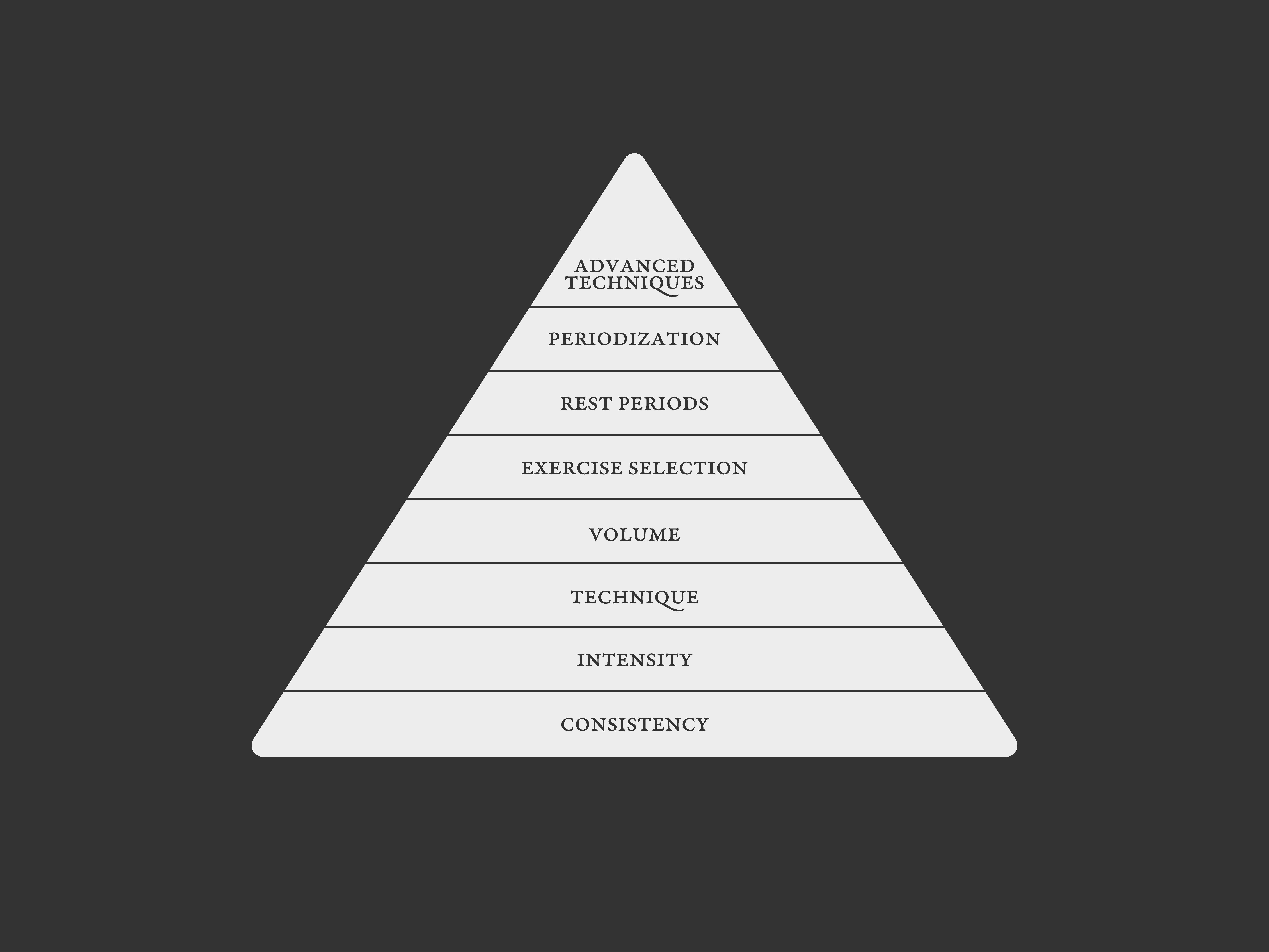
Muscle gain is not built from the top down. It’s built from the ground up.
The “Muscle-Building Hierarchy” organizes hypertrophy variables into a pyramid. Each layer supports the one above it. The higher you climb, the smaller the marginal returns—and the more advanced the application. If the base is unstable, nothing above it matters much.
The First Layer: Consistency
This is the foundation. Training three times per week for years will outperform six perfect weeks followed by three inconsistent months. Hypertrophy is cumulative. Muscle tissue responds to repeated stimulus over time, not isolated peaks of effort.
Consistency includes:
- Showing up regularly
- Maintaining adequate protein intake
- Sleeping sufficiently
- Progressing over months and years
Without consistency, every other variable becomes irrelevant. It doesn’t matter how optimal your program is if it isn’t sustained.
Layer 2: Intensity
Once consistency is present, effort becomes the next major driver. Muscle growth requires sufficient proximity to failure. Sets performed too far from muscular fatigue fail to recruit high-threshold motor units—the fibers with the greatest growth potential.
Intensity here does not mean maximal load. It means meaningful effort relative to your capacity, consistently. Most productive hypertrophy training occurs within roughly 0–3 reps in reserve on working sets. That means enough reps with enough weight to reach that zone often enough in a practical way. When effort is too consistently too low, volume becomes “junk.” When effort is too consistently maximal, recovery becomes compromised.
Effort must be deliberate and repeatable.
Layer 3: Technique
Technique determines whether tension reaches the intended muscle effectively.
Poor execution redistributes load to secondary movers, connective tissue, or momentum too much. The result is reduced stimulus where you want it and increased fatigue where you don’t.
Technique refinement typically includes:
- Controlled eccentrics
- Stable joint positioning
- Consistent range of motion
- Intentional targeting
Better technique often increases growth without increasing load; meaning if you’re grasping at straws trying to figure out how to progressively overload without increasing weight or reps, tightening your technique is often the way to go.
Layer 4: Volume
Once you are consistent, training hard, and executing movements well, volume becomes a primary growth lever.
Volume is best understood as the number of challenging sets performed per muscle group per week. Research in hypertrophy consistently shows a dose-response relationship up to a point: more hard sets generally produce more growth, until recovery capacity is exceeded. Beginners can grow a lot on relatively low volumes, but also reap the benefits from high volume (if they stay consistent). Advanced lifters sometimes require more to continue progressing, but crucially they tend to be able to get more out of a set than beginners from intensity; this is why many advanced lifters trend more towards low volume.
The key is finding the highest recoverable volume, not the highest possible volume. You don’t have to choose one or the other; listen to your body.
Layer 5: Exercise Selection
Exercise selection refines stimulus distribution.
At the base of the pyramid, almost any reasonable compound movements will build muscle. Many people make the mistake of thinking this layer is the base of the pyramid or that exercise selection is the most useful advice a personal trainer can give. As you advance, strategic selection becomes more important for addressing weak points and achieving balanced development.
Factors that matter:
- Stability
- Lengthened loading potential
- Joint tolerance
- Muscle-specific bias
A stable machine press may stimulate the chest more effectively for some lifters than a barbell press. A lengthened-biased movement may produce greater hypertrophic stimulus than a shortened-only variation. Exercise selection fine-tunes stimulus once foundational variables are optimized. Often, though, it comes down to individual preference; as long as you’re hitting all the muscles, the exercises, machines, and setups you like tend to be better for your gains.
Layer 6: Rest Periods
Rest periods influence performance sustainability across sets.
Shorter rest intervals increase metabolic stress but can reduce load and rep output. Longer rest periods preserve performance and mechanical tension. For hypertrophy, rest periods in the 1.5–3 minute range often allow for better volume quality in compound movements, while isolation work may tolerate shorter intervals.
Rest manipulation produces incremental improvements, not transformational ones. It matters more once intensity and volume are already appropriate. Try out both using a timer and using just your intuition for rest periods, and see which feels better for you. For many, just feeling when you’re ready for the next set will often suffice.
Layer 7: Periodization
Periodization organizes training stress across time.
Instead of pushing every variable simultaneously, structured phases allow for focused progression. Volume blocks, intensity blocks, deloads, and specialization phases help manage fatigue and direct adaptation.
For intermediate and advanced lifters, undulating or block periodization models help avoid stagnation. Strategic variation maintains stimulus novelty while respecting recovery.
Periodization becomes increasingly valuable as absolute loads rise and adaptive windows narrow. If your progressive overloading is intact and you prefer a stripped-down simple approach to periodization, a typical guideline is “deload every 6-8 weeks.”
Layer 8: Advanced Techniques
At the top of the pyramid lies advanced techniques for increasing muscle stimulus—tools for squeezing out additional growth efficiently when simpler progression slows.
These include drop sets, myoreps, and lengthened partials, discussed in Advanced Techniques in Technique Tips. These methods can increase effective reps, extend sets beyond initial failure, and amplify stimulus in time-efficient formats. They’re useful for advanced lifters who already control volume, effort, and recovery. They’re unnecessary and often counterproductive for lifters who lack consistency or sufficient baseline intensity.
The higher you climb in the hierarchy, the smaller the gains and the narrower the margin for error.
Why the Pyramid Matters
Many lifters invert the hierarchy. They chase advanced methods as a panacea before mastering effort. They debate exercise variations before building consistent training habits. They manipulate rest intervals while skipping sessions. The pyramid corrects that impulse.
If progress stalls, look down a level before looking up.
- Are you consistent?
- Are sets hard enough?
- Is technique stable?
- Is volume appropriate and recoverable?
Only after those questions are answered should you reach for advanced tools.

The Muscle-Building Hierarchy
Most lifters search for growth in the wrong places. Tweak rest periods. They experiment with intensity techniques, debating optimal exercise variations. Meanwhile, the real limiter often sits at the bottom of the pyramid.
Lifestyle
Beginner
Muscle gain is not built from the top down. It’s built from the ground up.
The “Muscle-Building Hierarchy” organizes hypertrophy variables into a pyramid. Each layer supports the one above it. The higher you climb, the smaller the marginal returns—and the more advanced the application. If the base is unstable, nothing above it matters much.
The First Layer: Consistency
This is the foundation. Training three times per week for years will outperform six perfect weeks followed by three inconsistent months. Hypertrophy is cumulative. Muscle tissue responds to repeated stimulus over time, not isolated peaks of effort.
Consistency includes:
- Showing up regularly
- Maintaining adequate protein intake
- Sleeping sufficiently
- Progressing over months and years
Without consistency, every other variable becomes irrelevant. It doesn’t matter how optimal your program is if it isn’t sustained.
Layer 2: Intensity
Once consistency is present, effort becomes the next major driver. Muscle growth requires sufficient proximity to failure. Sets performed too far from muscular fatigue fail to recruit high-threshold motor units—the fibers with the greatest growth potential.
Intensity here does not mean maximal load. It means meaningful effort relative to your capacity, consistently. Most productive hypertrophy training occurs within roughly 0–3 reps in reserve on working sets. That means enough reps with enough weight to reach that zone often enough in a practical way. When effort is too consistently too low, volume becomes “junk.” When effort is too consistently maximal, recovery becomes compromised.
Effort must be deliberate and repeatable.
Layer 3: Technique
Technique determines whether tension reaches the intended muscle effectively.
Poor execution redistributes load to secondary movers, connective tissue, or momentum too much. The result is reduced stimulus where you want it and increased fatigue where you don’t.
Technique refinement typically includes:
- Controlled eccentrics
- Stable joint positioning
- Consistent range of motion
- Intentional targeting
Better technique often increases growth without increasing load; meaning if you’re grasping at straws trying to figure out how to progressively overload without increasing weight or reps, tightening your technique is often the way to go.
Layer 4: Volume
Once you are consistent, training hard, and executing movements well, volume becomes a primary growth lever.
Volume is best understood as the number of challenging sets performed per muscle group per week. Research in hypertrophy consistently shows a dose-response relationship up to a point: more hard sets generally produce more growth, until recovery capacity is exceeded. Beginners can grow a lot on relatively low volumes, but also reap the benefits from high volume (if they stay consistent). Advanced lifters sometimes require more to continue progressing, but crucially they tend to be able to get more out of a set than beginners from intensity; this is why many advanced lifters trend more towards low volume.
The key is finding the highest recoverable volume, not the highest possible volume. You don’t have to choose one or the other; listen to your body.
Layer 5: Exercise Selection
Exercise selection refines stimulus distribution.
At the base of the pyramid, almost any reasonable compound movements will build muscle. Many people make the mistake of thinking this layer is the base of the pyramid or that exercise selection is the most useful advice a personal trainer can give. As you advance, strategic selection becomes more important for addressing weak points and achieving balanced development.
Factors that matter:
- Stability
- Lengthened loading potential
- Joint tolerance
- Muscle-specific bias
A stable machine press may stimulate the chest more effectively for some lifters than a barbell press. A lengthened-biased movement may produce greater hypertrophic stimulus than a shortened-only variation. Exercise selection fine-tunes stimulus once foundational variables are optimized. Often, though, it comes down to individual preference; as long as you’re hitting all the muscles, the exercises, machines, and setups you like tend to be better for your gains.
Layer 6: Rest Periods
Rest periods influence performance sustainability across sets.
Shorter rest intervals increase metabolic stress but can reduce load and rep output. Longer rest periods preserve performance and mechanical tension. For hypertrophy, rest periods in the 1.5–3 minute range often allow for better volume quality in compound movements, while isolation work may tolerate shorter intervals.
Rest manipulation produces incremental improvements, not transformational ones. It matters more once intensity and volume are already appropriate. Try out both using a timer and using just your intuition for rest periods, and see which feels better for you. For many, just feeling when you’re ready for the next set will often suffice.
Layer 7: Periodization
Periodization organizes training stress across time.
Instead of pushing every variable simultaneously, structured phases allow for focused progression. Volume blocks, intensity blocks, deloads, and specialization phases help manage fatigue and direct adaptation.
For intermediate and advanced lifters, undulating or block periodization models help avoid stagnation. Strategic variation maintains stimulus novelty while respecting recovery.
Periodization becomes increasingly valuable as absolute loads rise and adaptive windows narrow. If your progressive overloading is intact and you prefer a stripped-down simple approach to periodization, a typical guideline is “deload every 6-8 weeks.”
Layer 8: Advanced Techniques
At the top of the pyramid lies advanced techniques for increasing muscle stimulus—tools for squeezing out additional growth efficiently when simpler progression slows.
These include drop sets, myoreps, and lengthened partials, discussed in Advanced Techniques in Technique Tips. These methods can increase effective reps, extend sets beyond initial failure, and amplify stimulus in time-efficient formats. They’re useful for advanced lifters who already control volume, effort, and recovery. They’re unnecessary and often counterproductive for lifters who lack consistency or sufficient baseline intensity.
The higher you climb in the hierarchy, the smaller the gains and the narrower the margin for error.
Why the Pyramid Matters
Many lifters invert the hierarchy. They chase advanced methods as a panacea before mastering effort. They debate exercise variations before building consistent training habits. They manipulate rest intervals while skipping sessions. The pyramid corrects that impulse.
If progress stalls, look down a level before looking up.
- Are you consistent?
- Are sets hard enough?
- Is technique stable?
- Is volume appropriate and recoverable?
Only after those questions are answered should you reach for advanced tools.

The Muscle-Building Hierarchy
Most lifters search for growth in the wrong places. Tweak rest periods. They experiment with intensity techniques, debating optimal exercise variations. Meanwhile, the real limiter often sits at the bottom of the pyramid.
Lifestyle
Beginner
Muscle gain is not built from the top down. It’s built from the ground up.
The “Muscle-Building Hierarchy” organizes hypertrophy variables into a pyramid. Each layer supports the one above it. The higher you climb, the smaller the marginal returns—and the more advanced the application. If the base is unstable, nothing above it matters much.
The First Layer: Consistency
This is the foundation. Training three times per week for years will outperform six perfect weeks followed by three inconsistent months. Hypertrophy is cumulative. Muscle tissue responds to repeated stimulus over time, not isolated peaks of effort.
Consistency includes:
- Showing up regularly
- Maintaining adequate protein intake
- Sleeping sufficiently
- Progressing over months and years
Without consistency, every other variable becomes irrelevant. It doesn’t matter how optimal your program is if it isn’t sustained.
Layer 2: Intensity
Once consistency is present, effort becomes the next major driver. Muscle growth requires sufficient proximity to failure. Sets performed too far from muscular fatigue fail to recruit high-threshold motor units—the fibers with the greatest growth potential.
Intensity here does not mean maximal load. It means meaningful effort relative to your capacity, consistently. Most productive hypertrophy training occurs within roughly 0–3 reps in reserve on working sets. That means enough reps with enough weight to reach that zone often enough in a practical way. When effort is too consistently too low, volume becomes “junk.” When effort is too consistently maximal, recovery becomes compromised.
Effort must be deliberate and repeatable.
Layer 3: Technique
Technique determines whether tension reaches the intended muscle effectively.
Poor execution redistributes load to secondary movers, connective tissue, or momentum too much. The result is reduced stimulus where you want it and increased fatigue where you don’t.
Technique refinement typically includes:
- Controlled eccentrics
- Stable joint positioning
- Consistent range of motion
- Intentional targeting
Better technique often increases growth without increasing load; meaning if you’re grasping at straws trying to figure out how to progressively overload without increasing weight or reps, tightening your technique is often the way to go.
Layer 4: Volume
Once you are consistent, training hard, and executing movements well, volume becomes a primary growth lever.
Volume is best understood as the number of challenging sets performed per muscle group per week. Research in hypertrophy consistently shows a dose-response relationship up to a point: more hard sets generally produce more growth, until recovery capacity is exceeded. Beginners can grow a lot on relatively low volumes, but also reap the benefits from high volume (if they stay consistent). Advanced lifters sometimes require more to continue progressing, but crucially they tend to be able to get more out of a set than beginners from intensity; this is why many advanced lifters trend more towards low volume.
The key is finding the highest recoverable volume, not the highest possible volume. You don’t have to choose one or the other; listen to your body.
Layer 5: Exercise Selection
Exercise selection refines stimulus distribution.
At the base of the pyramid, almost any reasonable compound movements will build muscle. Many people make the mistake of thinking this layer is the base of the pyramid or that exercise selection is the most useful advice a personal trainer can give. As you advance, strategic selection becomes more important for addressing weak points and achieving balanced development.
Factors that matter:
- Stability
- Lengthened loading potential
- Joint tolerance
- Muscle-specific bias
A stable machine press may stimulate the chest more effectively for some lifters than a barbell press. A lengthened-biased movement may produce greater hypertrophic stimulus than a shortened-only variation. Exercise selection fine-tunes stimulus once foundational variables are optimized. Often, though, it comes down to individual preference; as long as you’re hitting all the muscles, the exercises, machines, and setups you like tend to be better for your gains.
Layer 6: Rest Periods
Rest periods influence performance sustainability across sets.
Shorter rest intervals increase metabolic stress but can reduce load and rep output. Longer rest periods preserve performance and mechanical tension. For hypertrophy, rest periods in the 1.5–3 minute range often allow for better volume quality in compound movements, while isolation work may tolerate shorter intervals.
Rest manipulation produces incremental improvements, not transformational ones. It matters more once intensity and volume are already appropriate. Try out both using a timer and using just your intuition for rest periods, and see which feels better for you. For many, just feeling when you’re ready for the next set will often suffice.
Layer 7: Periodization
Periodization organizes training stress across time.
Instead of pushing every variable simultaneously, structured phases allow for focused progression. Volume blocks, intensity blocks, deloads, and specialization phases help manage fatigue and direct adaptation.
For intermediate and advanced lifters, undulating or block periodization models help avoid stagnation. Strategic variation maintains stimulus novelty while respecting recovery.
Periodization becomes increasingly valuable as absolute loads rise and adaptive windows narrow. If your progressive overloading is intact and you prefer a stripped-down simple approach to periodization, a typical guideline is “deload every 6-8 weeks.”
Layer 8: Advanced Techniques
At the top of the pyramid lies advanced techniques for increasing muscle stimulus—tools for squeezing out additional growth efficiently when simpler progression slows.
These include drop sets, myoreps, and lengthened partials, discussed in Advanced Techniques in Technique Tips. These methods can increase effective reps, extend sets beyond initial failure, and amplify stimulus in time-efficient formats. They’re useful for advanced lifters who already control volume, effort, and recovery. They’re unnecessary and often counterproductive for lifters who lack consistency or sufficient baseline intensity.
The higher you climb in the hierarchy, the smaller the gains and the narrower the margin for error.
Why the Pyramid Matters
Many lifters invert the hierarchy. They chase advanced methods as a panacea before mastering effort. They debate exercise variations before building consistent training habits. They manipulate rest intervals while skipping sessions. The pyramid corrects that impulse.
If progress stalls, look down a level before looking up.
- Are you consistent?
- Are sets hard enough?
- Is technique stable?
- Is volume appropriate and recoverable?
Only after those questions are answered should you reach for advanced tools.

Placeholder Title
Placeholder Subtitle
Lifestyle
Beginner
Muscle gain is not built from the top down. It’s built from the ground up.
The “Muscle-Building Hierarchy” organizes hypertrophy variables into a pyramid. Each layer supports the one above it. The higher you climb, the smaller the marginal returns—and the more advanced the application. If the base is unstable, nothing above it matters much.
The First Layer: Consistency
This is the foundation. Training three times per week for years will outperform six perfect weeks followed by three inconsistent months. Hypertrophy is cumulative. Muscle tissue responds to repeated stimulus over time, not isolated peaks of effort.
Consistency includes:
- Showing up regularly
- Maintaining adequate protein intake
- Sleeping sufficiently
- Progressing over months and years
Without consistency, every other variable becomes irrelevant. It doesn’t matter how optimal your program is if it isn’t sustained.
Layer 2: Intensity
Once consistency is present, effort becomes the next major driver. Muscle growth requires sufficient proximity to failure. Sets performed too far from muscular fatigue fail to recruit high-threshold motor units—the fibers with the greatest growth potential.
Intensity here does not mean maximal load. It means meaningful effort relative to your capacity, consistently. Most productive hypertrophy training occurs within roughly 0–3 reps in reserve on working sets. That means enough reps with enough weight to reach that zone often enough in a practical way. When effort is too consistently too low, volume becomes “junk.” When effort is too consistently maximal, recovery becomes compromised.
Effort must be deliberate and repeatable.
Layer 3: Technique
Technique determines whether tension reaches the intended muscle effectively.
Poor execution redistributes load to secondary movers, connective tissue, or momentum too much. The result is reduced stimulus where you want it and increased fatigue where you don’t.
Technique refinement typically includes:
- Controlled eccentrics
- Stable joint positioning
- Consistent range of motion
- Intentional targeting
Better technique often increases growth without increasing load; meaning if you’re grasping at straws trying to figure out how to progressively overload without increasing weight or reps, tightening your technique is often the way to go.
Layer 4: Volume
Once you are consistent, training hard, and executing movements well, volume becomes a primary growth lever.
Volume is best understood as the number of challenging sets performed per muscle group per week. Research in hypertrophy consistently shows a dose-response relationship up to a point: more hard sets generally produce more growth, until recovery capacity is exceeded. Beginners can grow a lot on relatively low volumes, but also reap the benefits from high volume (if they stay consistent). Advanced lifters sometimes require more to continue progressing, but crucially they tend to be able to get more out of a set than beginners from intensity; this is why many advanced lifters trend more towards low volume.
The key is finding the highest recoverable volume, not the highest possible volume. You don’t have to choose one or the other; listen to your body.
Layer 5: Exercise Selection
Exercise selection refines stimulus distribution.
At the base of the pyramid, almost any reasonable compound movements will build muscle. Many people make the mistake of thinking this layer is the base of the pyramid or that exercise selection is the most useful advice a personal trainer can give. As you advance, strategic selection becomes more important for addressing weak points and achieving balanced development.
Factors that matter:
- Stability
- Lengthened loading potential
- Joint tolerance
- Muscle-specific bias
A stable machine press may stimulate the chest more effectively for some lifters than a barbell press. A lengthened-biased movement may produce greater hypertrophic stimulus than a shortened-only variation. Exercise selection fine-tunes stimulus once foundational variables are optimized. Often, though, it comes down to individual preference; as long as you’re hitting all the muscles, the exercises, machines, and setups you like tend to be better for your gains.
Layer 6: Rest Periods
Rest periods influence performance sustainability across sets.
Shorter rest intervals increase metabolic stress but can reduce load and rep output. Longer rest periods preserve performance and mechanical tension. For hypertrophy, rest periods in the 1.5–3 minute range often allow for better volume quality in compound movements, while isolation work may tolerate shorter intervals.
Rest manipulation produces incremental improvements, not transformational ones. It matters more once intensity and volume are already appropriate. Try out both using a timer and using just your intuition for rest periods, and see which feels better for you. For many, just feeling when you’re ready for the next set will often suffice.
Layer 7: Periodization
Periodization organizes training stress across time.
Instead of pushing every variable simultaneously, structured phases allow for focused progression. Volume blocks, intensity blocks, deloads, and specialization phases help manage fatigue and direct adaptation.
For intermediate and advanced lifters, undulating or block periodization models help avoid stagnation. Strategic variation maintains stimulus novelty while respecting recovery.
Periodization becomes increasingly valuable as absolute loads rise and adaptive windows narrow. If your progressive overloading is intact and you prefer a stripped-down simple approach to periodization, a typical guideline is “deload every 6-8 weeks.”
Layer 8: Advanced Techniques
At the top of the pyramid lies advanced techniques for increasing muscle stimulus—tools for squeezing out additional growth efficiently when simpler progression slows.
These include drop sets, myoreps, and lengthened partials, discussed in Advanced Techniques in Technique Tips. These methods can increase effective reps, extend sets beyond initial failure, and amplify stimulus in time-efficient formats. They’re useful for advanced lifters who already control volume, effort, and recovery. They’re unnecessary and often counterproductive for lifters who lack consistency or sufficient baseline intensity.
The higher you climb in the hierarchy, the smaller the gains and the narrower the margin for error.
Why the Pyramid Matters
Many lifters invert the hierarchy. They chase advanced methods as a panacea before mastering effort. They debate exercise variations before building consistent training habits. They manipulate rest intervals while skipping sessions. The pyramid corrects that impulse.
If progress stalls, look down a level before looking up.
- Are you consistent?
- Are sets hard enough?
- Is technique stable?
- Is volume appropriate and recoverable?
Only after those questions are answered should you reach for advanced tools.