
All About Sprinting
Sprinting is one of the most natural—and demanding—forms of human movement. It’s explosive, technical, and unforgiving. While it often gets lumped into “conditioning,” sprinting sits at the intersection of strength, speed, coordination, and cardiovascular fitness. Done well, it’s a powerful training tool. Done carelessly, it’s also one of the fastest ways to get hurt. Understanding what sprinting offers and what it requires is essential before making it part of your routine.
Technique Tips
Advanced
Why Sprinting Is So Effective
Sprinting places unique demands on the body that slower forms of cardio don’t replicate. Key benefits include:
- Power and speed development: sprinting trains rapid force production, heavily recruiting fast-twitch muscle fibers that are critical for athletic performance and overall strength carryover.
- High neuromuscular demand: the coordination between hips, legs, arms, and trunk challenges the nervous system in ways steady-state movement doesn’t.
- Efficient conditioning: short sprint sessions can significantly improve aerobic and anaerobic capacity, including VO₂ max, with minimal time investment.
- Bone and connective tissue loading: the high ground reaction forces involved in sprinting stimulate bone density and tendon adaptation when progressed appropriately.
Sprinting Technique
You don’t need to sprint like an Olympic athlete to benefit, but technique really matters. Small errors are magnified at high speeds.
Posture and Position
- Tall, stacked posture through the torso
- Slight forward lean from the ankles, not the waist
- Head neutral, eyes forward
Arm Action
- Arms drive the legs
- Elbows bent roughly 90 degrees
- Hands move cheek-to-pocket, not across the body
Leg Mechanics
- Powerful push into the ground, not reaching forward
- Quick ground contact times
- Knee drives forward and up naturally, not forced
A useful cue: push the ground away and let speed happen, rather than trying to “run fast” by overstriding.
Acceleration vs Top Speed
Not all sprinting is the same. There’s acceleration work (shorter sprints, starting slower) emphasizing strength and force production, and there’s top speed sprinting (longer sprints once speed is built) placing higher demands on elasticity and coordination. Beginners usually benefit most from acceleration-focused sprints, which are easier to control and less risky, whereas conditioned athletes may benefit more from training their top speed more.
Things to Consider Before You Sprint
Warm-ups are non-negotiable. Cold sprinting is a recipe for strains. A proper warm-up should include:
- Light aerobic movement
- Dynamic mobility (hips, ankles, hamstrings)
- Gradual build-up runs before full effort
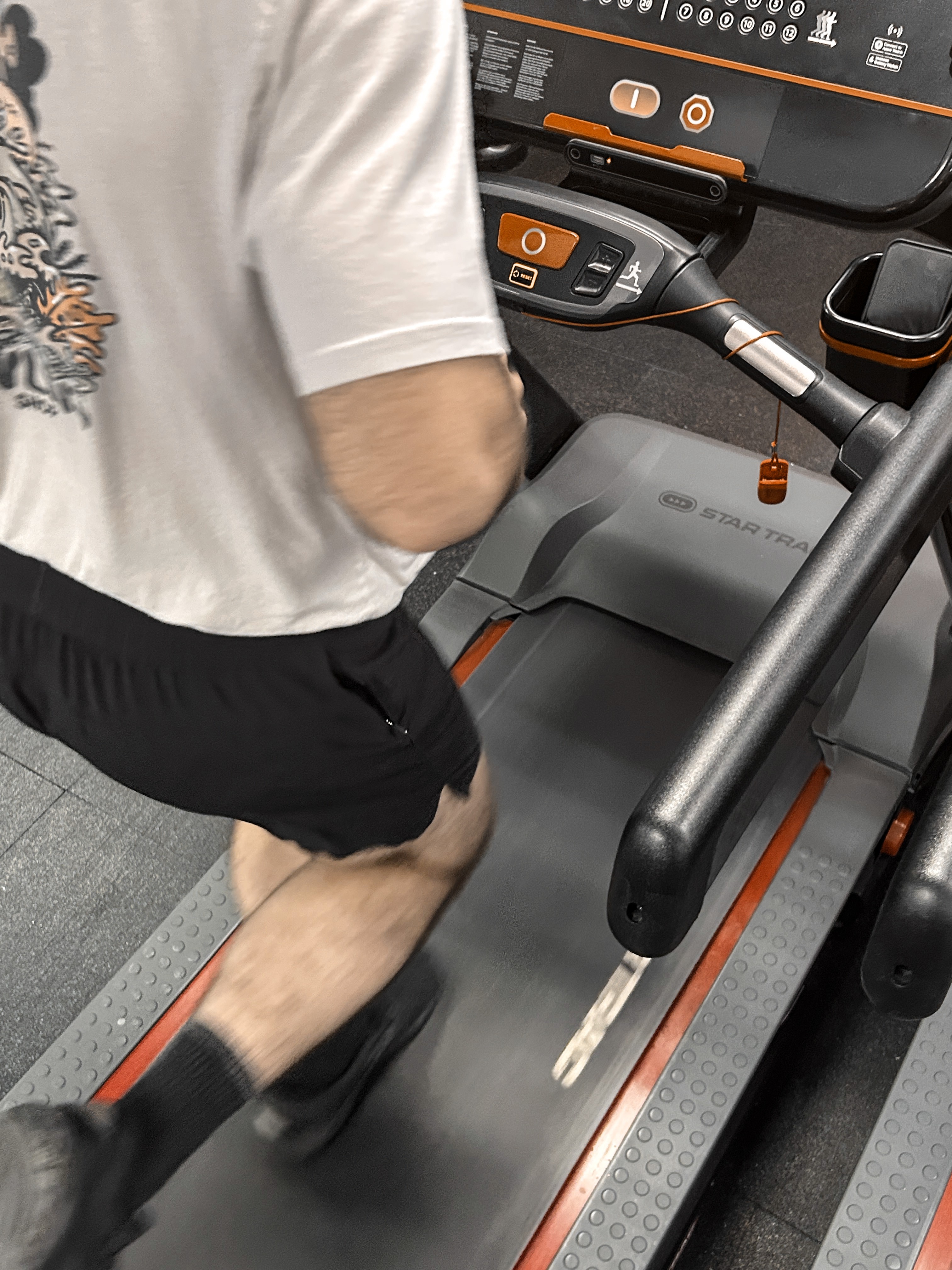
Consider the surface. Grass, turf, or track are generally more forgiving and enjoyable than concrete or treadmills. Hard or uneven surfaces increase injury risk.
Volume stays low. Sprinting is about quality, not quantity. If you’re grinding, you’re no longer sprinting. This means short distances, full recovery between efforts, and stop when speed drops noticeably.
Recovery Cost Is High
Sprint sessions tax the nervous system and connective tissues heavily. They should be limited to 1–2 sessions per week for most people, placed away from heavy lower-body lifting days, and balanced with adequate sleep and nutrition, as always.
Who Sprinting Is (and Isn’t) For
Sprinting is a great fit if:
- You already have a base of strength and conditioning
- You want athletic, agile, performance-oriented fitness
- You enjoy short, intense efforts
It’s not appropriate if:
- You’re new to exercise or returning from injury
- You have unresolved hamstring, Achilles, or hip issues
- Recovery resources are already stretched thin
In those cases, building toward sprinting with strength work, tempo runs, or hill sprints can be a smarter path.
Sources & Resources
- American College of Sports Medicine - Sprint Interval Training and Its Effects on Central Hemodynamical Factors
- PubMed, NIH, University of Queensland -Long-term metabolic and skeletal muscle adaptations to short-sprint training: implications for sprint training and tapering
- PubMed, NIH, Kristiania University College, University of Agder, Norwegian University of Science and Technology - The Training and Development of Elite Sprint Performance: an Integration of Scientific and Best Practice Literature


All About Sprinting
Sprinting is one of the most natural—and demanding—forms of human movement. It’s explosive, technical, and unforgiving. While it often gets lumped into “conditioning,” sprinting sits at the intersection of strength, speed, coordination, and cardiovascular fitness. Done well, it’s a powerful training tool. Done carelessly, it’s also one of the fastest ways to get hurt. Understanding what sprinting offers and what it requires is essential before making it part of your routine.
Technique Tips
Advanced
Why Sprinting Is So Effective
Sprinting places unique demands on the body that slower forms of cardio don’t replicate. Key benefits include:
- Power and speed development: sprinting trains rapid force production, heavily recruiting fast-twitch muscle fibers that are critical for athletic performance and overall strength carryover.
- High neuromuscular demand: the coordination between hips, legs, arms, and trunk challenges the nervous system in ways steady-state movement doesn’t.
- Efficient conditioning: short sprint sessions can significantly improve aerobic and anaerobic capacity, including VO₂ max, with minimal time investment.
- Bone and connective tissue loading: the high ground reaction forces involved in sprinting stimulate bone density and tendon adaptation when progressed appropriately.
Sprinting Technique
You don’t need to sprint like an Olympic athlete to benefit, but technique really matters. Small errors are magnified at high speeds.
Posture and Position
- Tall, stacked posture through the torso
- Slight forward lean from the ankles, not the waist
- Head neutral, eyes forward
Arm Action
- Arms drive the legs
- Elbows bent roughly 90 degrees
- Hands move cheek-to-pocket, not across the body
Leg Mechanics
- Powerful push into the ground, not reaching forward
- Quick ground contact times
- Knee drives forward and up naturally, not forced
A useful cue: push the ground away and let speed happen, rather than trying to “run fast” by overstriding.
Acceleration vs Top Speed
Not all sprinting is the same. There’s acceleration work (shorter sprints, starting slower) emphasizing strength and force production, and there’s top speed sprinting (longer sprints once speed is built) placing higher demands on elasticity and coordination. Beginners usually benefit most from acceleration-focused sprints, which are easier to control and less risky, whereas conditioned athletes may benefit more from training their top speed more.
Things to Consider Before You Sprint
Warm-ups are non-negotiable. Cold sprinting is a recipe for strains. A proper warm-up should include:
- Light aerobic movement
- Dynamic mobility (hips, ankles, hamstrings)
- Gradual build-up runs before full effort
Consider the surface. Grass, turf, or track are generally more forgiving and enjoyable than concrete or treadmills. Hard or uneven surfaces increase injury risk.
Volume stays low. Sprinting is about quality, not quantity. If you’re grinding, you’re no longer sprinting. This means short distances, full recovery between efforts, and stop when speed drops noticeably.
Recovery Cost Is High
Sprint sessions tax the nervous system and connective tissues heavily. They should be limited to 1–2 sessions per week for most people, placed away from heavy lower-body lifting days, and balanced with adequate sleep and nutrition, as always.
Who Sprinting Is (and Isn’t) For
Sprinting is a great fit if:
- You already have a base of strength and conditioning
- You want athletic, agile, performance-oriented fitness
- You enjoy short, intense efforts
It’s not appropriate if:
- You’re new to exercise or returning from injury
- You have unresolved hamstring, Achilles, or hip issues
- Recovery resources are already stretched thin
In those cases, building toward sprinting with strength work, tempo runs, or hill sprints can be a smarter path.
Sources & Resources
- American College of Sports Medicine - Sprint Interval Training and Its Effects on Central Hemodynamical Factors
- PubMed, NIH, University of Queensland -Long-term metabolic and skeletal muscle adaptations to short-sprint training: implications for sprint training and tapering
- PubMed, NIH, Kristiania University College, University of Agder, Norwegian University of Science and Technology - The Training and Development of Elite Sprint Performance: an Integration of Scientific and Best Practice Literature

All About Sprinting
Sprinting is one of the most natural—and demanding—forms of human movement. It’s explosive, technical, and unforgiving. While it often gets lumped into “conditioning,” sprinting sits at the intersection of strength, speed, coordination, and cardiovascular fitness. Done well, it’s a powerful training tool. Done carelessly, it’s also one of the fastest ways to get hurt. Understanding what sprinting offers and what it requires is essential before making it part of your routine.
Technique Tips
Advanced
Why Sprinting Is So Effective
Sprinting places unique demands on the body that slower forms of cardio don’t replicate. Key benefits include:
- Power and speed development: sprinting trains rapid force production, heavily recruiting fast-twitch muscle fibers that are critical for athletic performance and overall strength carryover.
- High neuromuscular demand: the coordination between hips, legs, arms, and trunk challenges the nervous system in ways steady-state movement doesn’t.
- Efficient conditioning: short sprint sessions can significantly improve aerobic and anaerobic capacity, including VO₂ max, with minimal time investment.
- Bone and connective tissue loading: the high ground reaction forces involved in sprinting stimulate bone density and tendon adaptation when progressed appropriately.
Sprinting Technique
You don’t need to sprint like an Olympic athlete to benefit, but technique really matters. Small errors are magnified at high speeds.
Posture and Position
- Tall, stacked posture through the torso
- Slight forward lean from the ankles, not the waist
- Head neutral, eyes forward
Arm Action
- Arms drive the legs
- Elbows bent roughly 90 degrees
- Hands move cheek-to-pocket, not across the body
Leg Mechanics
- Powerful push into the ground, not reaching forward
- Quick ground contact times
- Knee drives forward and up naturally, not forced
A useful cue: push the ground away and let speed happen, rather than trying to “run fast” by overstriding.
Acceleration vs Top Speed
Not all sprinting is the same. There’s acceleration work (shorter sprints, starting slower) emphasizing strength and force production, and there’s top speed sprinting (longer sprints once speed is built) placing higher demands on elasticity and coordination. Beginners usually benefit most from acceleration-focused sprints, which are easier to control and less risky, whereas conditioned athletes may benefit more from training their top speed more.
Things to Consider Before You Sprint
Warm-ups are non-negotiable. Cold sprinting is a recipe for strains. A proper warm-up should include:
- Light aerobic movement
- Dynamic mobility (hips, ankles, hamstrings)
- Gradual build-up runs before full effort
Consider the surface. Grass, turf, or track are generally more forgiving and enjoyable than concrete or treadmills. Hard or uneven surfaces increase injury risk.
Volume stays low. Sprinting is about quality, not quantity. If you’re grinding, you’re no longer sprinting. This means short distances, full recovery between efforts, and stop when speed drops noticeably.
Recovery Cost Is High
Sprint sessions tax the nervous system and connective tissues heavily. They should be limited to 1–2 sessions per week for most people, placed away from heavy lower-body lifting days, and balanced with adequate sleep and nutrition, as always.
Who Sprinting Is (and Isn’t) For
Sprinting is a great fit if:
- You already have a base of strength and conditioning
- You want athletic, agile, performance-oriented fitness
- You enjoy short, intense efforts
It’s not appropriate if:
- You’re new to exercise or returning from injury
- You have unresolved hamstring, Achilles, or hip issues
- Recovery resources are already stretched thin
In those cases, building toward sprinting with strength work, tempo runs, or hill sprints can be a smarter path.
Sources & Resources
- American College of Sports Medicine - Sprint Interval Training and Its Effects on Central Hemodynamical Factors
- PubMed, NIH, University of Queensland -Long-term metabolic and skeletal muscle adaptations to short-sprint training: implications for sprint training and tapering
- PubMed, NIH, Kristiania University College, University of Agder, Norwegian University of Science and Technology - The Training and Development of Elite Sprint Performance: an Integration of Scientific and Best Practice Literature

All About Sprinting
Sprinting is one of the most natural—and demanding—forms of human movement. It’s explosive, technical, and unforgiving. While it often gets lumped into “conditioning,” sprinting sits at the intersection of strength, speed, coordination, and cardiovascular fitness. Done well, it’s a powerful training tool. Done carelessly, it’s also one of the fastest ways to get hurt. Understanding what sprinting offers and what it requires is essential before making it part of your routine.
Technique Tips
Beginner
Why Sprinting Is So Effective
Sprinting places unique demands on the body that slower forms of cardio don’t replicate. Key benefits include:
- Power and speed development: sprinting trains rapid force production, heavily recruiting fast-twitch muscle fibers that are critical for athletic performance and overall strength carryover.
- High neuromuscular demand: the coordination between hips, legs, arms, and trunk challenges the nervous system in ways steady-state movement doesn’t.
- Efficient conditioning: short sprint sessions can significantly improve aerobic and anaerobic capacity, including VO₂ max, with minimal time investment.
- Bone and connective tissue loading: the high ground reaction forces involved in sprinting stimulate bone density and tendon adaptation when progressed appropriately.
Sprinting Technique
You don’t need to sprint like an Olympic athlete to benefit, but technique really matters. Small errors are magnified at high speeds.
Posture and Position
- Tall, stacked posture through the torso
- Slight forward lean from the ankles, not the waist
- Head neutral, eyes forward
Arm Action
- Arms drive the legs
- Elbows bent roughly 90 degrees
- Hands move cheek-to-pocket, not across the body
Leg Mechanics
- Powerful push into the ground, not reaching forward
- Quick ground contact times
- Knee drives forward and up naturally, not forced
A useful cue: push the ground away and let speed happen, rather than trying to “run fast” by overstriding.
Acceleration vs Top Speed
Not all sprinting is the same. There’s acceleration work (shorter sprints, starting slower) emphasizing strength and force production, and there’s top speed sprinting (longer sprints once speed is built) placing higher demands on elasticity and coordination. Beginners usually benefit most from acceleration-focused sprints, which are easier to control and less risky, whereas conditioned athletes may benefit more from training their top speed more.
Things to Consider Before You Sprint
Warm-ups are non-negotiable. Cold sprinting is a recipe for strains. A proper warm-up should include:
- Light aerobic movement
- Dynamic mobility (hips, ankles, hamstrings)
- Gradual build-up runs before full effort
Consider the surface. Grass, turf, or track are generally more forgiving and enjoyable than concrete or treadmills. Hard or uneven surfaces increase injury risk.
Volume stays low. Sprinting is about quality, not quantity. If you’re grinding, you’re no longer sprinting. This means short distances, full recovery between efforts, and stop when speed drops noticeably.
Recovery Cost Is High
Sprint sessions tax the nervous system and connective tissues heavily. They should be limited to 1–2 sessions per week for most people, placed away from heavy lower-body lifting days, and balanced with adequate sleep and nutrition, as always.
Who Sprinting Is (and Isn’t) For
Sprinting is a great fit if:
- You already have a base of strength and conditioning
- You want athletic, agile, performance-oriented fitness
- You enjoy short, intense efforts
It’s not appropriate if:
- You’re new to exercise or returning from injury
- You have unresolved hamstring, Achilles, or hip issues
- Recovery resources are already stretched thin
In those cases, building toward sprinting with strength work, tempo runs, or hill sprints can be a smarter path.
Sources & Resources
- American College of Sports Medicine - Sprint Interval Training and Its Effects on Central Hemodynamical Factors
- PubMed, NIH, University of Queensland -Long-term metabolic and skeletal muscle adaptations to short-sprint training: implications for sprint training and tapering
- PubMed, NIH, Kristiania University College, University of Agder, Norwegian University of Science and Technology - The Training and Development of Elite Sprint Performance: an Integration of Scientific and Best Practice Literature